M74
M74
| Home | Astro Links | Special Interest | Market Corner |
On the night on October 25th, 1998 I set up for an astro-photo run shortly
after dinner with the intention of capturing one of my favorite target
types, a fainter galaxy. M74 is one of the more inviting targets during
this period, and not in my portfolio. So I set up and shot (2) long 60
minute exposures with the intention of either getting one good one or double
stacking both. The film was PPF-400 and I had already used about 10 frames
during that dark moon period, so this was to be my last shoot. In addition,
I was finally getting the hang of using my 216XT as a standalone guider
and also learning proper drift aligning.
The night was clear and seeing was relatively steady, neighbors security
lights were to present an eventual problem with the exposures. I did get
2 shots, first exposure at 7:30 EST and second starting at 8:40, both with
low numbers on the guider and no error codes.
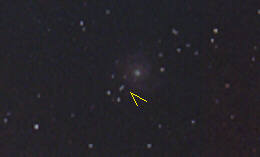
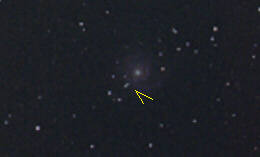
I dropped the film off the next day, Monday October 26th and picked it up on Tuesday, October 27th. Although I checked the pics over, I was disappointed in the M74 shots because they had a lot of sky fog. I think the security lighting had contributed to the fogging. I set them aside until Friday. That was when I finally took a lupe to the exposures and the negs......and here is what I found....(this is an enlargement of M74 region, yellow points to ? object)....
|
|
| Exposure 1 - 12:30 UT, Oct. 26, 1998
M74 |
Exposure 2 - 01:40 UT, Oct. 26, 1998
M74 |
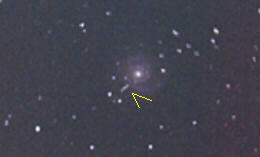
I did some minor processing and combined the images in Corel for this
story and this is the result...
 |
Central
Bureau for Astronomical Telegrams
That site contains a description of what to do about potential discoveries,
verification, reported, and a whole lot of links to various sites for verifying
discoveries, I then cross linked to the Minor Planet Center site which
is:
Minor
Planet Center
These sites are very important to those with purported discoveries.
It is crucial that you undertake any avenue you can to obtain "secondary"
and even "third" verification of a potential discovery before reporting
it. Actually, the approach I took was to try and "disprove" my own
discovery before involving any other parties. So I accessed the site to
check for possible minor planets at:
This site was actually set up to check for possible minor planets around Galaxies, as an aid in Super Nova discovery.
So I entered the following into the submit form:
1998 10 26.02 (which is 12:30 am UT on
Oct. 26, 1998), M74 as the target Galaxy, 15 arc. minutes radius of search
and V=15 (my actual estimated maximum magnitude of the object, based on
the photos, was around V=13).
The following was outputted as shown:
Object designation
R.A. Decl.
V Offsets
Motion/hr
h m
° '
R.A. Decl. R.A. Decl.
(312) Pierretta 01 36.92 +15 47.3 13.0 3.2E 0.3N 0.6- 0.1-
End of list
BINGO! A hit! But was it my object?
Next I broke out my MEGASTAR, indexed it on the date and time in question,
updated the asteroid positions and ran a locate asteroid on (312 Pierretta).
I purposely did not check MEGASTAR before the Planet Center because I wanted
to cross verify BACK to the map, not the other way! Here is what Megastar
showed as a 10 point (1 per 2 hours) position of this Asteroid:
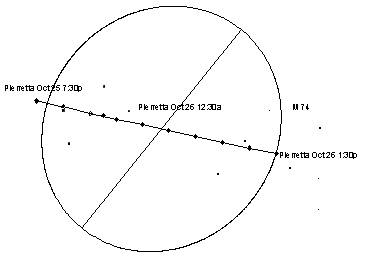
As can be clearly seen, asteroid 312 Pierretta was just leaving the
(5) star asterism and heading toward the center of M74 right at 1:30 am
UT on October 26th, if you compare this to my pictures above, you can clearly
see that the position is the same.
AND SO THE EXCITEMENT WANES...............
Actually, I am tickled to have gone thru this experience, and was able
to follow a methodical process in checking my "potential" discovery. I
was able to avoid involving others from having to spend their time and
learned valuable investigative lessons along the way. In addition, I now
have clear photo examples in my file of asteroid appearance and movement.
"The lessons not learned are the only ones wasted"
I hope others can gain from my experience.